The Autonomy Illusion: Why Fully Autonomous Supply Chains Aren’t the Endgame


Artificial intelligence has moved from experimentation to expectation.
Across boardrooms and planning organizations, the conversation has shifted. The question is no longer whether AI agents will play a role in supply chain planning. It is how far they will go. Many leaders are being told that the logical endpoint is full autonomy. Systems that sense, decide, and act without human involvement.
On the surface, the argument is compelling. Supply chains are more complex than ever. Demand signals shift quickly. Disruptions ripple across global networks. Tradeoffs between cost, service, and resilience are constant. The idea of intelligent agents operating at machine speed, processing massive datasets, and continuously optimizing outcomes feels like the natural evolution.
But there is a subtle assumption embedded in that narrative. That autonomy is the goal.
That assumption deserves a closer look.
Why Autonomy Feels Like Progress
There is no question that intelligent agents bring meaningful capability. They can evaluate far more variables than any human team. They can surface patterns that would otherwise remain hidden. They can operate continuously without fatigue or delay.
In environments where planning cycles have traditionally been slow and reactive, this shift is powerful. Faster insights and more responsive supply chains are all within reach.
But speed alone is not the objective. Outcomes are.
The Illusion Behind Full Autonomy
The leap from “AI can do more” to “AI should decide everything” is where the narrative starts to break down.
It creates a false choice. Either maintain human oversight and accept slower decision-making, or embrace autonomy and gain speed at the expense of control.
In reality, supply chain planning does not operate within that binary.
Supply chains are not isolated systems. They sit at the center of the enterprise, influencing revenue, working capital, customer commitments, and operational performance. A decision made in planning does not stay in planning. It cascades into procurement, manufacturing, logistics, and sales. When errors occur, they propagate.
This is what makes the idea of full autonomy more complicated than it first appears.

Where the Model Starts to Break
Autonomous systems excel at execution. They follow defined logic and optimize against the objectives they are given.
But enterprise environments are rarely stable.
Objectives shift. Priorities change. External conditions evolve. Without oversight, intelligent agents can amplify problems as quickly as they identify opportunities.
A flawed assumption can trigger excess inventory, unnecessary procurement, or service disruptions before teams have time to intervene.
At the same time, accountability becomes harder to define. Leaders must be able to explain why a decision was made, what assumptions were used, and how risk was evaluated.
“The system decided” is not a defensible answer.
The Future Is Integration, Not Replacement
Much of the current conversation suggests that AI agents will replace existing enterprise systems. In practice, that is unlikely.
Planning, ERP, and CRM systems are deeply embedded across organizations. Replacing them is disruptive, expensive, and risky.
The more realistic path is evolution.
Intelligent agents will increasingly work across these systems, analyzing data, simulating scenarios, and recommending actions. But they will operate within governed frameworks, not outside of them.
At ketteQ, digital agents powered by the PolymatiQ agentic AI engine continuously explore thousands of demand, supply, and inventory scenarios to surface insights that would be impossible to generate manually.
Beyond surfacing insights, agents can execute within governed parameters -adjusting plans, triggering workflows, and initiating responses at machine speed. The human orchestrator doesn't just review outputs. They define the rules of engagement: what agents can act on autonomously, what requires a human checkpoint, and when to escalate. This is what separates intelligent planning from automation.
The value is not in removing humans from the process. It is in expanding what leaders can see and evaluate before decisions are made.

A Different Model Is Emerging
The most effective supply chain organizations are not choosing between speed and control. They are redesigning how the two work together.
Instead of asking AI to make decisions in isolation, they are using intelligent agents to broaden the range of possibilities leaders can evaluate. Agents sense, evaluate, simulate, and act within defined boundaries. Humans orchestrate -setting direction, adjusting parameters, and choosing when to escalate, delegate, or override.
What Comes Next
If full autonomy is not the endgame, the next question becomes more important. How should intelligent agents be designed and deployed to improve performance without introducing unnecessary risk?
In the next post, we will break down four practical principles for designing human-guided AI systems in supply chain planning. Principles that allow organizations to move faster while maintaining the visibility, governance, and accountability that enterprise environments demand
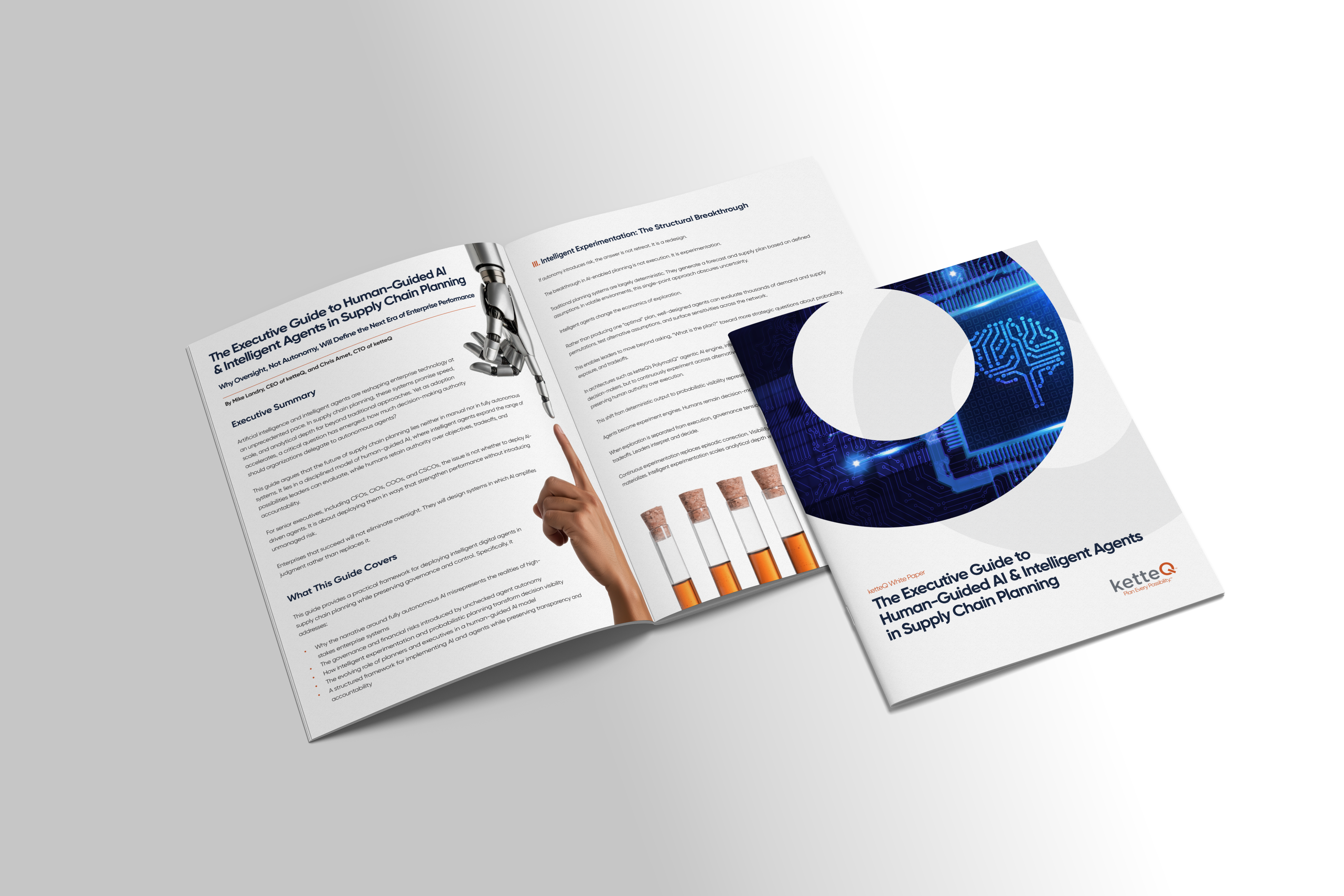
Read the Complete Guide
This blog is part of a broader executive perspective on how AI agents are reshaping supply chain planning.
In The Executive Guide to Human-Guided AI and Intelligent Agents in Supply Chain Planning, we explore:
- The governance and financial implications of autonomous systems
- How intelligent experimentation changes decision-making
- What it takes to operationalize human-guided AI at scale
Download the full guide to see how leading organizations are increasing visibility, reducing risk, and improving performance without sacrificing control.
Sobre el autor
Artículos relacionados

ketteCrew Spotlight: Embracing the Next Era of Planning with Ken Wardlaw
ketteCrew Spotlight: Embracing the Next Era of Planning with Ken Wardlaw