

A Smarter Approach to Improving Supply Chain Decisions


When organizations talk about improving supply chain performance, the conversation often jumps straight to technology. New platforms. New implementations. Big transformation programs.
But many supply chain leaders are starting to ask a different question:
What if better outcomes don’t require changing the system, just improving how decisions are made within it?
That shift in perspective is quietly reshaping how planning teams think about modernization.
The Pressure Isn’t on Systems — It’s on Decisions
Most planning organizations aren’t struggling because they lack data or tools. In fact, they often have more data and more sophisticated platforms than ever before. What’s harder is turning that information into timely, confident decisions as conditions change.
Planners are expected to balance service, cost, inventory, and capacity, not just once a month, but continuously. They need to understand tradeoffs, test alternatives, and respond faster without destabilizing operations.
Traditional planning models do a good job of enforcing structure and consistency. Where they tend to fall short is helping teams explore how else a plan could work when assumptions shift. A single recommended answer is useful, but it’s rarely sufficient when the real world refuses to behave like the model expects.
The opportunity isn’t to abandon structure. It’s to add intelligence around it.

Why “Modernization” Doesn’t Have to Mean Disruption
For years, modernization has been synonymous with replacement, but replacing a planning system is rarely just a technology decision. It’s a multi-year organizational effort involving new processes, retraining, and risk to service and financial performance along the way.
That’s why many teams are rethinking the goal altogether.
Instead of asking, “What system should we move to?” they’re asking, “How can we make better decisions with the system we already rely on?”
This is where an augmentation-first approach comes into focus. Rather than changing systems of record, organizations introduce an adaptive intelligence layer that operates above them, expanding decision capability without disrupting workflows, interfaces, or ownership.
It’s a quieter path forward, but often a more effective one.
From Static Plans to Adaptive Decision Cycles
At the center of this approach is a shift in how planning work gets done.
Instead of relying on a single deterministic planning run, teams introduce intelligent planning agents that operate continuously. These agents monitor conditions, initiate targeted experimentation, and evaluate a broader range of feasible alternatives, all within the constraints and models the organization already trusts.
PolymatiQ™, ketteQ’s agentic AI engine, was built specifically to power this kind of decision environment. It connects to existing planning platforms, retrieves the data and structure already in place, and runs multi-pass scenario exploration at speed. Each pass makes small adjustments, tests outcomes, and measures downstream impact.
The result isn’t automation for its own sake. It’s optionality.
Planners are presented with ranked, scored alternatives that reflect real tradeoffs; service versus cost, inventory versus responsiveness, and can apply human judgment where it matters most. The system doesn’t replace planners. It augments them.
Why Speed Matters More than Perfection
One of the most important shifts in this model is how organizations think about time.
In many environments, the cost of slow decision-making now outweighs the benefit of marginally better optimization. When replanning takes too long, organizations absorb excess inventory, miss revenue opportunities, or accept avoidable service penalties. Decision latency becomes a financial variable.
Agent-led planning shortens that cycle. By continuously exploring alternatives and updating recommendations as conditions evolve, teams can respond earlier, before small changes compound into larger problems.
This doesn’t mean giving up control. Guardrails remain in place. Transparency remains central. But the planning process becomes more responsive, more resilient, and more aligned with how the business actually operates.

A Smarter Way Forward — Without Forcing a Reset
What makes this approach compelling is its practicality.
Organizations don’t have to declare a multi-year transformation or commit to wholesale replacement. They can start with one high-impact domain — supply planning, capacity, inventory, order promising — and expand as value becomes visible.
Because intelligent planning agents operate on top of existing systems, adoption is measured in weeks, not years. Teams build confidence incrementally. Optionality is preserved. And modernization happens without forcing a reset of everything that already works.
For many leaders, this is what “smart” modernization looks like in 2026: adaptive, agent-led, augmentation-first, and grounded in real operational constraints.
Better decisions don’t always require new systems. Sometimes they just require seeing more possibilities.
Read the Complete Guide
To explore how agent-led planning works in practice — and how organizations are extending existing planning platforms with adaptive, multi-pass intelligence — read the full white paper:
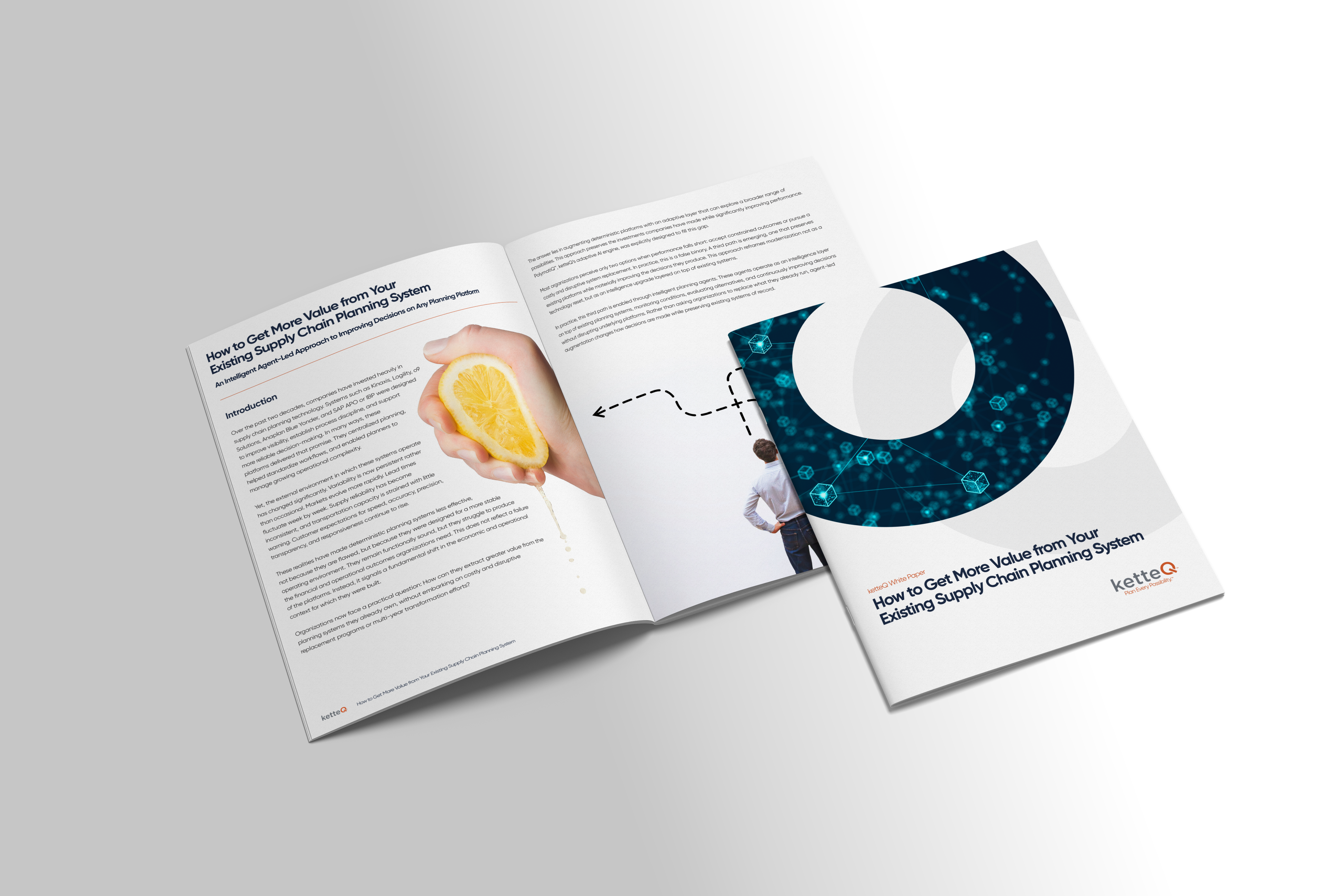
How to Get More Value from Your Existing Supply Chain Planning System
Download the complete guide to see the architecture, the approach, and real-world results in more detail.
Más información
Part 1: Why Your Supply Chain Planning System Still Has More to Give
Sobre el autor
Artículos relacionados

ketteCrew Spotlight: Embracing the Next Era of Planning with Ken Wardlaw
ketteCrew Spotlight: Embracing the Next Era of Planning with Ken Wardlaw